This past week we have had a very welcome break in the heat. Nights have been positively chilly and days beautiful. Sunday afternoon I cleaned up one of the foundation beds. I weeded out everything except the violets. I've decided to let them fill in as a ground cover under the shrubs since they are a larval host plant for fritillary butterflies. I saw quite a few investigating the patch while I worked. The back row is planted with fothergilla gardenii. In front of that are some dwarf iteas and dwarf clethra alnifolia. Two of the clethra 'Sixteen Candles' did not make it throught the summer heat. I was able to find 'Hummingbird' locally so planted two of them. I changed my mind yet again about the New Jersey Tea, ceanothus americanus and planted 20 quart sized seedlings as a front row.
All three kinds of shrubs get fuzzy white, fragrant flowers at one time or another during the year. They are supposed to be attractive to butterflies and hummingbirds.
Tuesday, September 18, 2007

Wednesday, August 29, 2007
Passionately prolific
I had read that the passion flower vine, passiflora incarnata, is called maypop because it pops up all over the yard. I can attest that this is true and may become a problem. So far the vine swarmed up all over the Carolina silverbell to the point that it was weighing the branches down dangerously. I pulled a bunch of it off the tree and discarded it but there's still plenty left. It has set quite a few blob shaped green fruits. At this unripe stage they have an odd scent, not exactly pleasant or unpleasant. I'll see what they're like when they ripen. I think they're supposed to be popular with squirrels and other critters.
Friday, August 3, 2007
Change of plans
It's so much easier to move plants in my head than with a shovel. I have some New Jersey Tea (Ceanothus americanus) that I was going to plant along the back edge of the wildflower meadow. I've been reading about maintenance and realized that you have to mow the thing each year, probably not a good thing for a shrub like the NJ tea. I think that instead I will move the too tall redtwig dogwoods out from under the pine tree in the front yard and replace it with the 2 foot tall NJ tea and keep woody plants out of the meadow.
This is both a host and nectar plant for butterflies. It also attracts insects that hummingbirds need to supplement their nectar diet.
This is both a host and nectar plant for butterflies. It also attracts insects that hummingbirds need to supplement their nectar diet.
New daylilies
I am not entirely pleased with my daylily border. There are too many that are the approximate color of a school bus when I prefer clear yellows and peachy colored ones. I'm sure I used to have some of the spider formed ones but they seem not to have made the move from the old house. I found a vendor with amazingly reasonable prices on daylilies and placed an order. I've requested that they hold the shipment until September when the weather cools a bit. Maybe these aren't the latest and hottest varieties but they are pretty colors and think they will improve the border.
http://www.alldaylilies.com/daylilies.htm
http://www.alldaylilies.com/daylilies.htm
Monday, July 16, 2007
Redbud, RIP
Several of us on my street had nice specimens of the redbud cultivar 'Forest Pansy', the one whose leaves hold a deep red color all season long. For no reason anyone could guess Jackie's tree failed to bloom or leaf out this spring and was finally pronounced past help. I looked out last week and saw that mine had turned completely
Virginia soil
Every one of my acid loving plants has started to turn yellow, a condition called chlorosis that usually means the soil is not acid enough to allow them to absorb iron. I had applied HollyTone and sulfur to the base of each earlier in the season but my next door neighbor pointed out that the roots have probably spread out further and the feeder roots are hitting our limestone soil. I've scratched the mulch away and applied the same mix at the drip line and watered it in. I hope that's the only problem. My native azaleas, mountain laurels and blueberries are all affected.
8/07/2007 Update:
I think this is working. At least some of the plants are starting to green up again!
8/07/2007 Update:
I think this is working. At least some of the plants are starting to green up again!
Passion flower

This is a new thing for me. It's Passiflora incarnata, called Maypop because its habit is to die to the ground in the winter and then pop up all over the place in May. I planted it last year and it performed as promised. It's growing up through the branches of a Carolina silverbell (Halesia tetraptera). Here are the first flowers I've seen. It is caterpillar food for Zebra Longwing and Variegated and Gulf Frittilary butterfly larvae.
Viburnum berries ripening
It looks like all my viburnums set fruit but they're ripening at different rates.
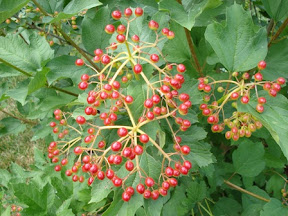
V. trilobum (American cranberrybush) - Partly ripe.
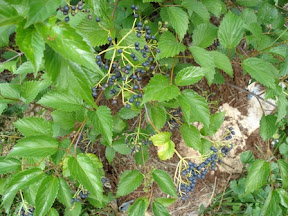
V. dentatum (Arrowwood) - Fully ripe
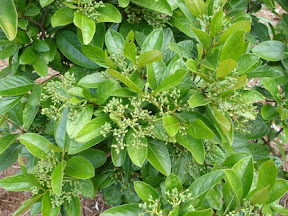
V. nudum (Possumhaw) - Not even begun to ripen.
V. trilobum (American cranberrybush) - Partly ripe.
V. dentatum (Arrowwood) - Fully ripe
V. nudum (Possumhaw) - Not even begun to ripen.
Subscribe to:
Posts (Atom)

 Posts
Posts


